How Dead Letter Exchanges Prevent Distributed Systems From Silently Failing
One bad payment event can keep thousands of healthy events waiting. The interesting part is not what a DLX is - it is deciding which failures should leave the hot path, and what happens after they do.
The most dangerous message in a queue is not the one that fails. It is the one that fails forever while the system keeps treating it as recoverable.
Message queues are built around a reassuring promise: work will not disappear just because a consumer crashes or a dependency becomes unavailable. If processing fails, the message can be delivered again.
That promise is essential. It also creates a problem that usually becomes visible only after the system is carrying real traffic.
Some failures recover on the next attempt. Others will never recover, regardless of how many times the message is delivered. When a system cannot tell the difference, reliability quietly turns into repetition.
The failure usually starts with something harmless. A payment service publishes an event:
{
  "type": "PaymentCompleted",
  "paymentId": "pay_40291",
  "orderId": "ord_7128"
}An email consumer receives the event and tries to load the customer details required for a receipt. The customer database is down, so the consumer returns the message to the queue.
Another worker receives it almost immediately. Same database. Same failure. Same requeue. The system is technically behaving as designed: no message has been lost, and every failed delivery is retried.
Operationally, nothing useful is happening.
The dependency has not recovered. The message is not any more processable than it was two milliseconds ago. Healthy messages are beginning to wait. Adding consumers only creates more traffic against the dependency that is already failing. A mechanism intended to preserve work has become a retry storm.
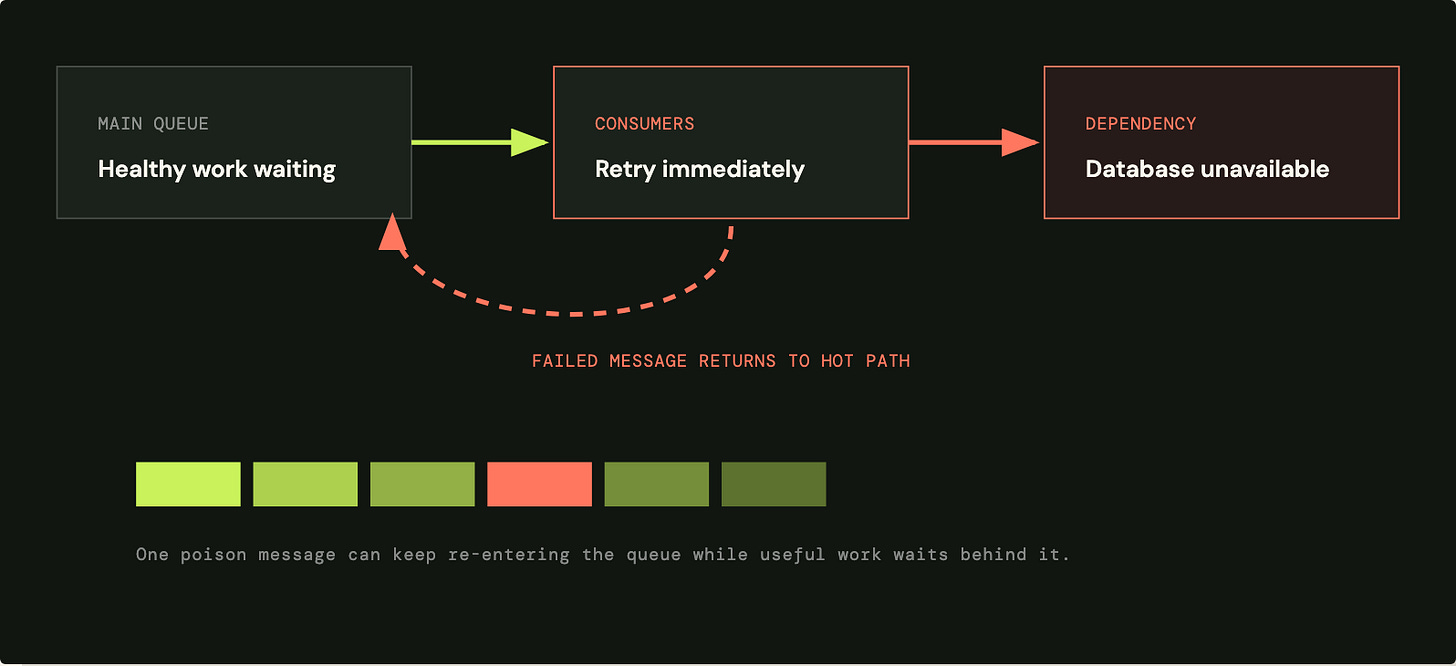 Immediate requeue protects the message, but it can turn one failure into system-wide load.
This is where queue reliability becomes more interesting than acknowledging or retrying a message. The system needs to decide when a failure should leave the normal processing path, without deleting the business event and without letting it block everything behind it.
Every queue needs somewhere for temporarily or permanently unprocessable work to go.
In RabbitMQ, that escape route is built around a Dead Letter Exchange. The feature itself is small. Designing the retry, recovery, ownership, and replay process around it is where the real engineering begins.
Try it before reading on. Inject a poison message with "Requeue forever", then switch to "Backoff + DLQ" and watch the healthy messages start flowing again.
Inject a poison message and watch what each policy does.
A queue needs an escape route#
Not all failed messages deserve the same treatment.
The database may be temporarily unavailable. Retrying later could work.
The payload may contain malformed JSON. Waiting five minutes will not repair it.
The producer may be sending an older schema that the consumer no longer understands. Every consumer will reject it in exactly the same way.
Treating those failures identically is how queues become self-inflicted incidents.
Temporary failure
Database timeout, rate limit, network error
                │
                ▼
        Retry after a delay

Permanent failure
Invalid JSON, missing field, unsupported schema
                │
                ▼
Stop automatic retries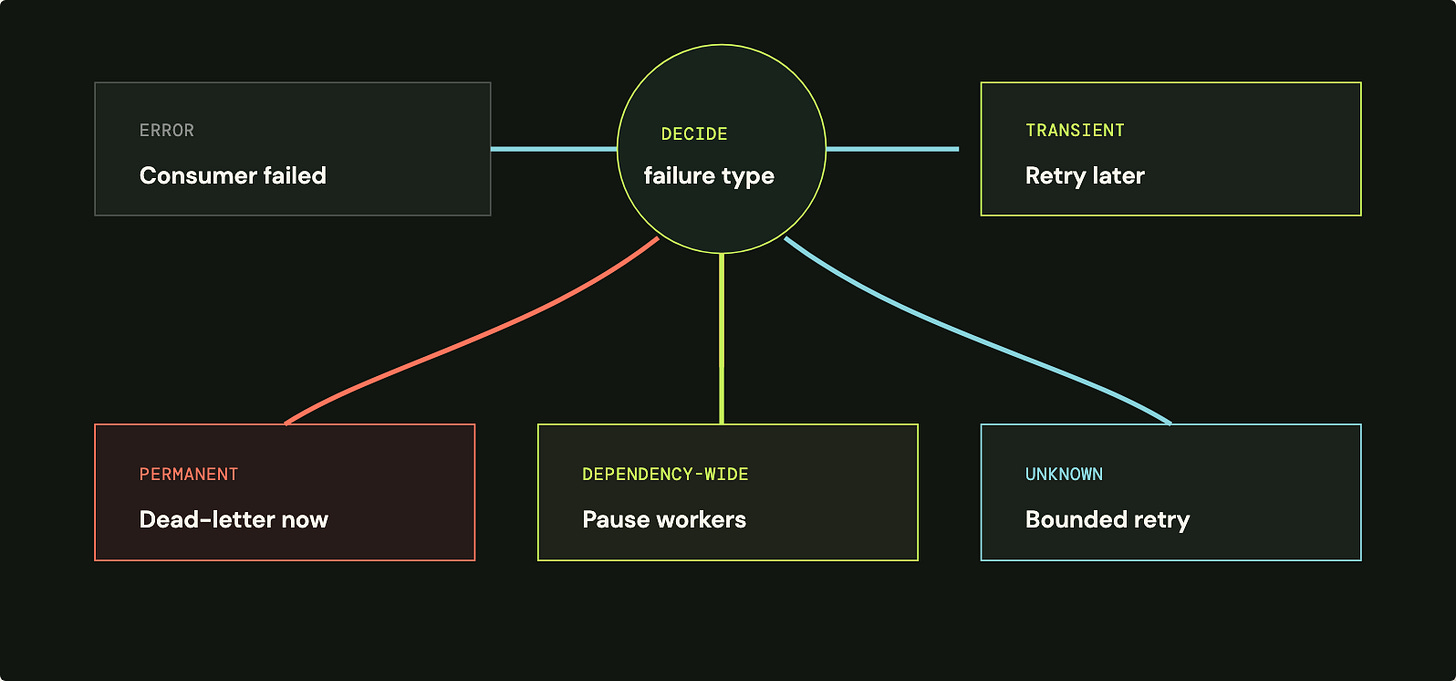 The consumer should classify the failure before choosing retry, pause, dead-letter, or bounded retry.
If every failure returns to the main queue, a poison message can circulate forever.
If every failure is deleted, important business events disappear.
A better approach is to remove unprocessable work from the hot path while keeping enough of it around for investigation, repair, and replay.
In RabbitMQ, that escape route is a Dead Letter Exchange, usually shortened to DLX.
The architecture#
Most queue-backed features start with a diagram that looks almost too clean:
Producer → Exchange → Queue → ConsumerProduction adds the routes that the happy-path diagram left out:
                         success
                            │
                            ▼
Producer → Exchange → Main Queue → Consumer → ACK
                                      │
                                      │ temporary failure
                                      ▼
                                  Retry Queue
                                      │
                                      │ retry delay expires
                                      ▼
                                   Main Queue
                                      │
                                      │ retry limit exceeded
                                      ▼
                             Dead Letter Exchange
                                      │
                                      ▼
                              Dead Letter Queue
                                      │
                                      ▼
Inspect → Repair → Replay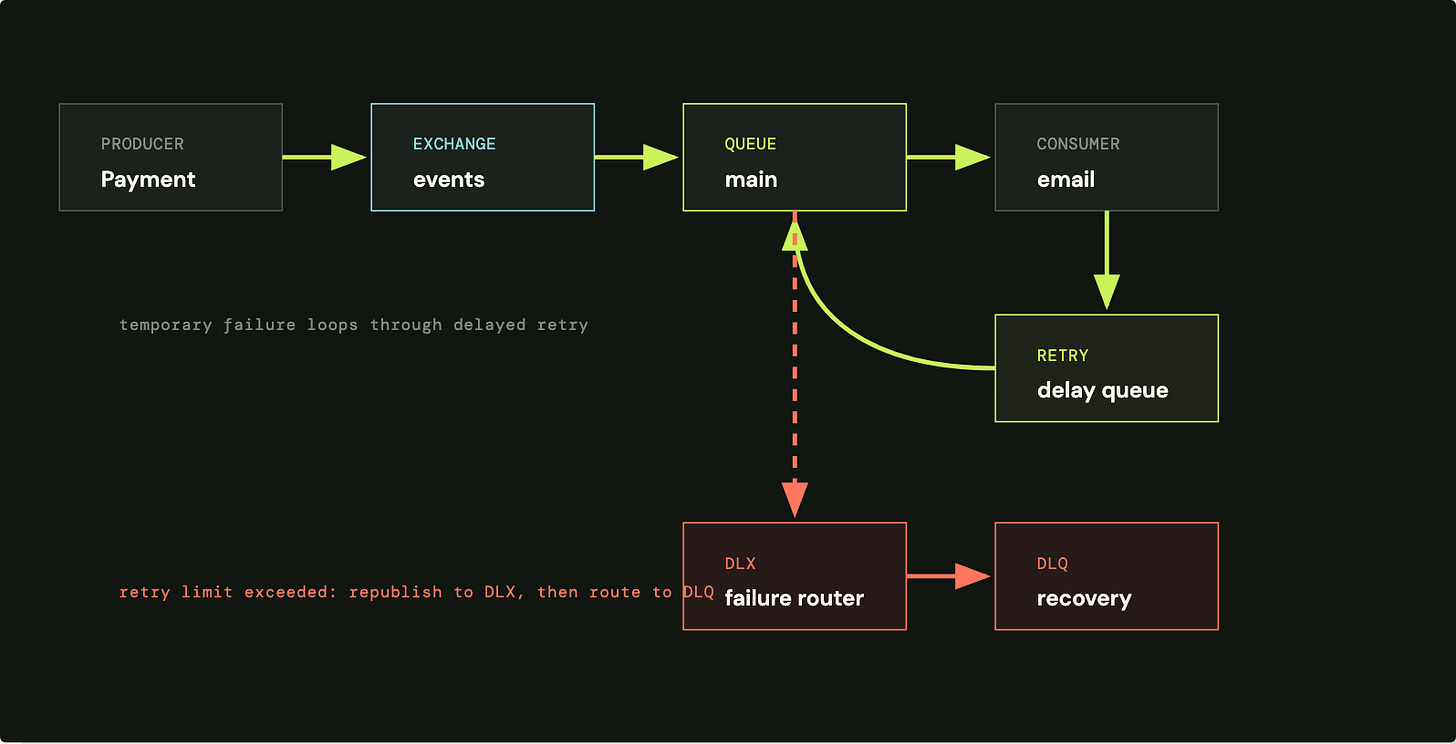 A DLX is an exchange, not a magic queue. Routing rules still decide where failed messages land.
This is the part worth slowing down on: the exchange and the queue are different things.
RabbitMQ does not move a failed message directly into a special queue. It republishes the message to an exchange. Normal exchange routing rules then decide where the message goes.
That extra step allows a system to:
-
send payment failures to a tightly controlled recovery queue;
-
route schema failures to a developer-owned queue;
-
copy security-sensitive failures into an audit pipeline;
-
collect failures from several queues without coupling them to one destination.
A DLX is not just a place where failed messages pile up. It is a routing layer for failure handling.
When does RabbitMQ dead-letter a message?#
RabbitMQ dead-letters a message only after a specific decision or queue condition. The common triggers are:
1. The consumer rejects it#
The consumer calls basic.reject with requeue=false.
2. The consumer negatively acknowledges it#
The consumer calls basic.nack with requeue=false.
3. The message expires#
The message exceeds its configured time-to-live.
4. The queue exceeds its length limit#
RabbitMQ removes or rejects messages according to the queue’s overflow configuration.
5. A quorum queue exceeds its delivery limit#
The message has been delivered too many times.
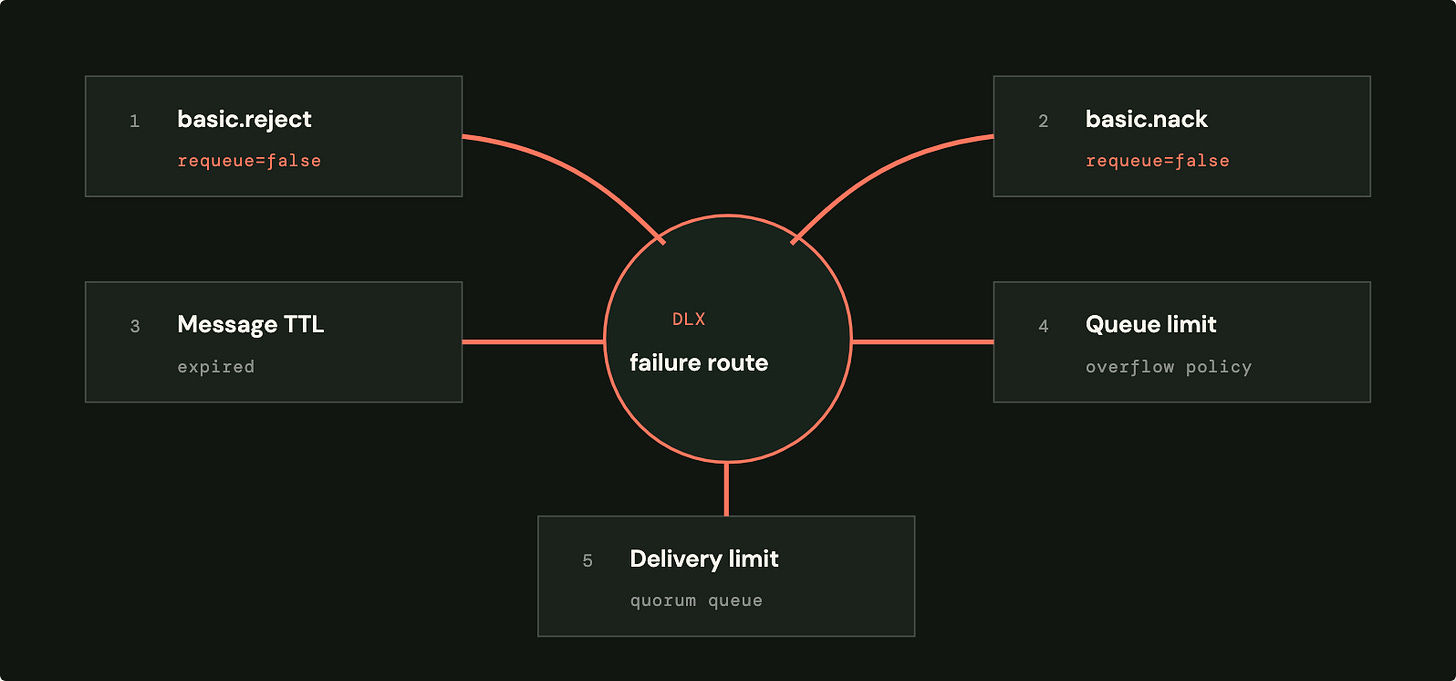 Dead-lettering begins when RabbitMQ has a reason to stop normal delivery and route the message elsewhere.
In consumer code, one boolean often decides whether the message keeps spinning in the same path or leaves it:
channel.nack(message, false, true);
//                                └─ requeue=true
// The message goes back toward the same queue.

channel.nack(message, false, false);
//                                └─ requeue=false
// The message can be routed through the configured DLX.A consumer crash is different. If a consumer disconnects before acknowledging a message, RabbitMQ normally requeues it automatically. That is redelivery, not necessarily dead-lettering.
That difference is easy to miss:
Redelivery describes another delivery attempt. Dead-lettering is a routing decision.
Configure the failure route#
Here is the shape in Node.js with amqplib.
import amqp from "amqplib";

const connection = await amqp.connect(process.env.RABBITMQ_URL);
const channel = await connection.createChannel();

const mainExchange = "payments.events";
const deadExchange = "payments.dead";
const mainQueue = "email.payment-completed";
const deadQueue = "email.payment-completed.dlq";

await channel.assertExchange(mainExchange, "topic", {
  durable: true
});

await channel.assertExchange(deadExchange, "topic", {
  durable: true
});

await channel.assertQueue(mainQueue, {
  durable: true,
  arguments: {
    "x-dead-letter-exchange": deadExchange,
    "x-dead-letter-routing-key": "email.payment.failed"
  }
});

await channel.bindQueue(
  mainQueue,
  mainExchange,
  "payment.completed"
);

await channel.assertQueue(deadQueue, {
  durable: true
});

await channel.bindQueue(
  deadQueue,
  deadExchange,
  "email.payment.failed"
);This is useful for showing the topology, but I would be careful about treating queue arguments as the whole production answer.
RabbitMQ policies are usually easier to operate because they can change DLX configuration without requiring applications to redeclare queues with different arguments.
Queue topology belongs to platform operations as much as it belongs to application code.
Do not retry every error#
The consumer has to classify the failure before it decides what to do with the message.
await channel.consume(mainQueue, async (message) => {
  if (!message) return;

  try {
    const event = JSON.parse(message.content.toString());

    validatePaymentEvent(event);
    await sendReceiptIdempotently(event);

    channel.ack(message);
  } catch (error) {
    if (isPermanentFailure(error)) {
      // Retrying cannot change this result.
      channel.nack(message, false, false);
      return;
    }

    // Publish into a delayed, bounded retry route.
    await scheduleRetry(message, error);
    channel.ack(message);
  }
});A useful classification is:
| Failure | Example | Response |
|---|---|---|
| Transient | Network timeout | Retry with delay |
| Dependency-wide | Database outage | Pause or trip a circuit breaker |
| Permanent | Invalid payload | Dead-letter immediately |
| Unknown | Unexpected consumer exception | Retry a small number of times, then dead-letter |
The dependency-wide case is where many retry designs fall apart.
If every message is failing because the same database is unavailable, pushing millions of messages through retry queues is theatre. A circuit breaker or paused consumer is usually more honest.
A DLQ isolates individual failures. It is not a replacement for controlling a system-wide outage.
Retry later, not immediately#
Immediate retries are fine for the kind of failure that disappears before you finish reading the log line.
They are harmful when the dependency needs minutes, not milliseconds, to recover.
A safer policy looks like:
Attempt 1 → immediate
Attempt 2 → wait 5 seconds
Attempt 3 → wait 30 seconds
Attempt 4 → wait 5 minutes
Still failing → DLQ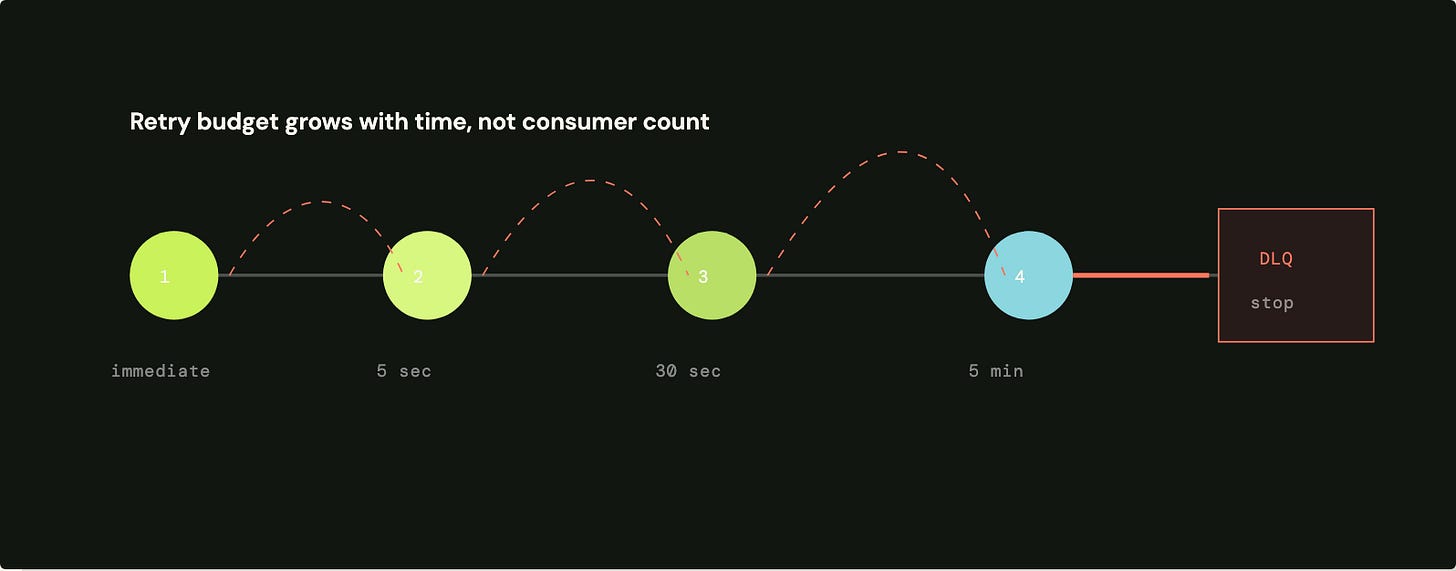 Backoff gives the dependency time to recover and limits how long the work remains in the hot path.
Add jitter so thousands of messages do not retry at the same moment.
delay = baseDelay × 2^attempt + randomJitterThe retry limit should come from the business operation, not from a constant someone copied between services.
A delayed email can tolerate a longer retry window. An inventory reservation may become useless after the checkout expires. A fraud decision may need to fail closed instead of waiting.
The correct retry budget depends on how long the work remains valuable.

The DLQ is not the recovery mechanism#
Creating a queue with .dlq in the name is the easy part.
The part teams underestimate is everything around it:
-
Who receives the alert?
-
How is the failure reason displayed?
-
Can messages be searched by event type or time range?
-
Who decides that replay is safe?
-
How quickly must a dead message be recovered?
-
What happens if replay fails again?
-
How long should sensitive payloads be retained?
Without those answers, a DLQ is just a quieter way to lose work.
The real recovery loop is:
Detect → Diagnose → Repair → Replay → Verify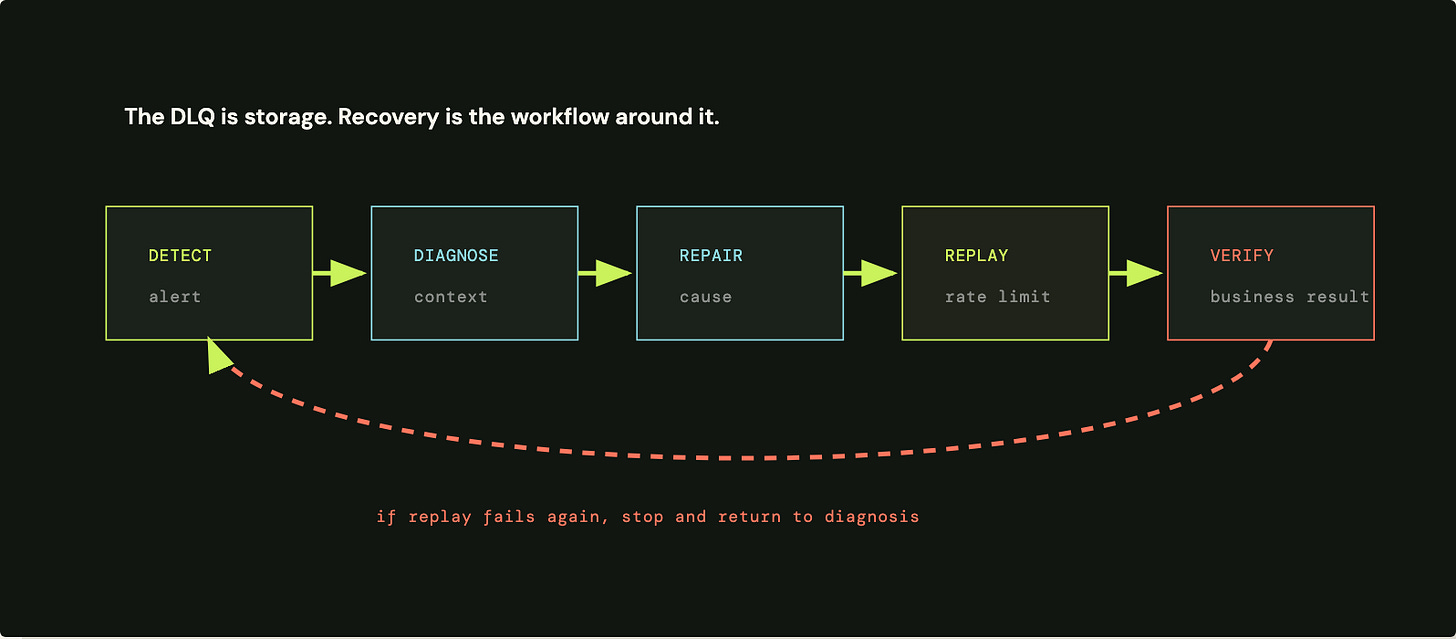 A useful DLQ has ownership, diagnostics, controlled replay, and verification after publishing.
Every stage needs an owner.
Detect#
Track more than queue depth:
-
dead-letter ingress rate;
-
oldest message age;
-
originating queue;
-
dead-letter reason;
-
event type;
-
replay success and failure rate.
Queue depth can look stable while messages are continuously entering and leaving the DLQ. Alerting only on depth can miss an active failure.
Diagnose#
Store enough context to understand the failure:
-
correlation ID;
-
event ID;
-
schema version;
-
original routing key;
-
consumer version;
-
error category;
-
first and latest failure timestamps.
RabbitMQ’s x-death header helps, but it should not be the only context an on-call engineer has at 2 a.m.
Repair#
The fix may be:
-
deploying corrected consumer code;
-
restoring a dependency;
-
migrating an old payload;
-
repairing business data;
-
accepting that the event is no longer valid.
Not every dead message should be replayed.
Replay#
Replay slowly, with the dashboard open.
Do not send 500,000 dead messages back into production at once. Even after the original bug is fixed, the replay load can become the next incident.
A replay tool should support:
-
filtering by failure type and time range;
-
dry-run validation;
-
rate limits;
-
pause and resume;
-
progress tracking;
-
an audit trail;
-
automatic stopping when failures increase.
Verify#
A successful publish is not recovery.
Verify that the consumer completed the business operation. Otherwise the replay tool may report success while messages are quietly dying again downstream.
Replays make idempotency mandatory#
Once replay exists, duplicate delivery is no longer a rare edge case.
A consumer may finish its database transaction and crash before acknowledging the message. RabbitMQ cannot know that the transaction succeeded, so it redelivers the event.
A replay intentionally creates another delivery.
So the consumer must be idempotent by design, not by hope.
For a payment event, a simple pattern is to store the event ID with a unique constraint:
CREATE TABLE processed_events (
  event_id TEXT PRIMARY KEY,
  processed_at TIMESTAMPTZ NOT NULL DEFAULT now()
);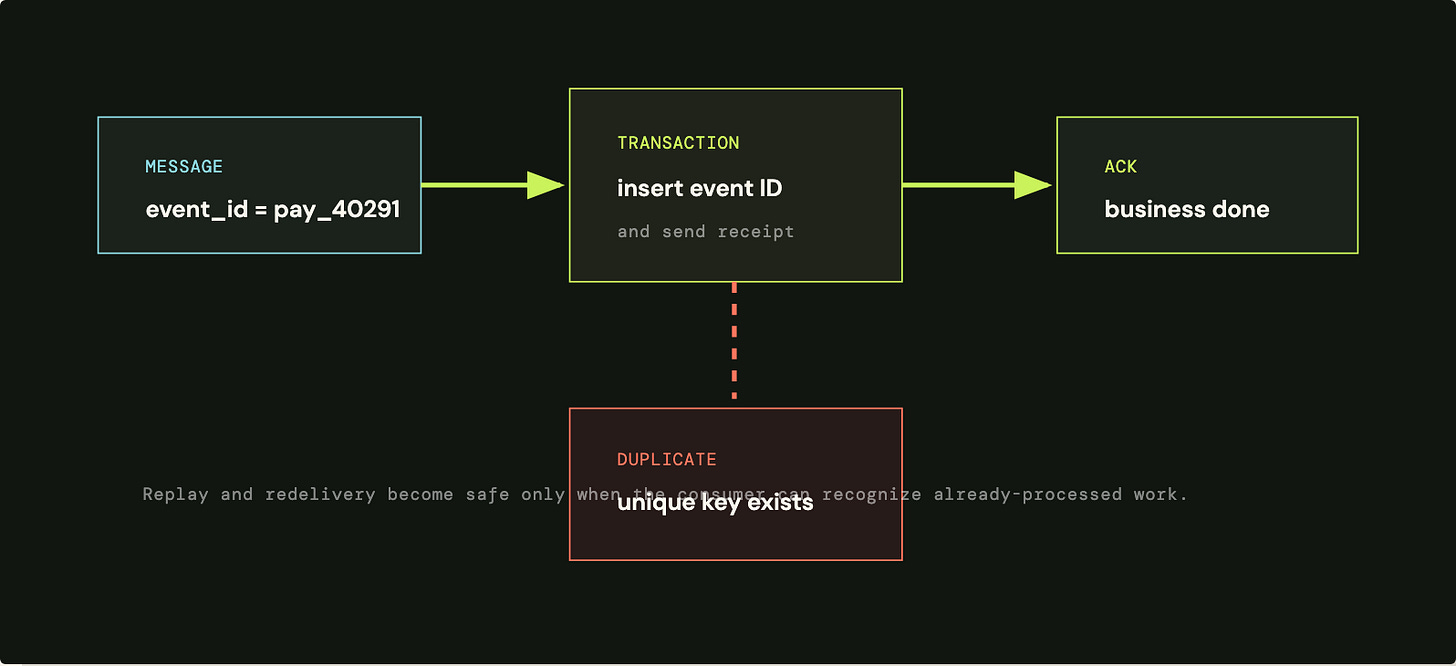 The event ID is the recovery boundary: the same message can arrive again without repeating the business operation.
The consumer inserts the event ID in the same transaction as the business change. If the ID already exists, the event has already been processed.
Idempotency is not a nice improvement to replay. It is the thing that makes replay safe.
Four details that change the design#
These are the details that tend to show up after the first real incident, which is exactly when you wish they had been designed in earlier.
Dead-lettering is another publish#
Moving a message from the source queue through a DLX is itself a publish operation.
“The source queue is durable and the DLQ is durable” does not automatically guarantee that the transfer between them cannot lose a message.
RabbitMQ quorum queues can support at-least-once dead-lettering, but that mode has specific requirements and additional resource cost. Choose the queue type and dead-letter strategy based on the importance of the event.
Per-message TTL is not a precise scheduler#
Expired messages may remain behind a non-expired message until they reach the head of a queue.
Putting many retry delays into one queue with per-message TTL can therefore produce surprising timing. Separate retry queues with fixed delays are often easier to reason about.
Dead-lettering can change ordering#
Moving one failed message aside allows later messages to continue.
That is often exactly what the system needs. It also means strict ordering is no longer intact.
If event B must never be processed before event A, dead-lettering A may violate a business invariant. Partitioning by entity, pausing that entity’s stream, or choosing a log-based architecture may be safer.
A parking lot is different from a DLQ#
The DLQ contains failures that are waiting for active recovery.
A parking-lot queue contains messages that failed recovery and now need deeper investigation or manual data repair.
Separating them prevents one permanently invalid message from cycling through the replay process forever.
When should you use a Dead Letter Exchange?#
Use one when:
-
an individual message can fail without invalidating the entire stream;
-
losing the business event is unacceptable;
-
failed messages need investigation or controlled replay;
-
later messages should continue processing;
-
consumers are designed for duplicates.
Do not treat it as the default answer when:
-
the entire dependency is unavailable;
-
strict ordering cannot be broken;
-
the work can be cheaply reconstructed from a database;
-
the payload contains data that should not be retained;
-
no team owns monitoring and replay;
-
dropping the event is an acceptable business decision.
Sometimes the correct failure policy is to pause consumption.
Sometimes it is to rebuild work from the source of truth.
Sometimes it is to reject the message and alert immediately.
The DLX is valuable because it gives the system another failure policy. It is not valuable because it makes every failure safe by default.
The lesson#
A Dead Letter Exchange protects the healthy path from work that cannot currently succeed.
But an exchange alone does not make the system reliable.
Reliability comes from the decisions around it:
-
classify failures instead of retrying everything;
-
delay and limit retries;
-
monitor dead-letter arrival;
-
preserve enough context to diagnose failures;
-
make consumers idempotent;
-
replay at a controlled rate;
-
separate repeat failures;
-
understand when ordering or transfer guarantees change.
Without monitoring, a dead-letter queue becomes a graveyard.
With ownership and a careful replay process, it becomes something much more useful:
A Dead Letter Queue isn’t where messages go to die.
It’s where distributed systems go to recover.